
Understand thermal behavior before the first prototype
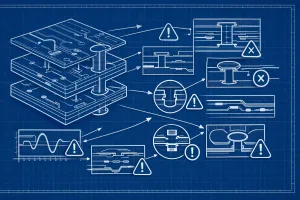
In PCB development, reliability is not defined by the schematic alone. Thermal behavior under real operating conditions is just as critical, and PCB-Investigator Physics helps engineers analyze current flow, voltage drop, trace resistance, and temperature distribution early in the design phase.
This becomes especially important in compact designs, high-current paths, and copper geometries with narrow sections or multiple vias. Layer stackups, component losses, and cooling conditions all interact, which means a quick back-of-the-envelope estimate is often not enough to predict the actual hot spots.
Electrical and thermal simulation in one workflow
PCB-Investigator Physics combines an electrical and thermal 3D field solver based directly on the PCB layout. The electric solver calculates potential and voltage distribution in traces, planes, and vias, while the thermal solver builds on that result to determine power dissipation and heat spreading in copper and FR4.
The result is a detailed temperature field that can be analyzed in steady-state or transient mode. This makes it possible to evaluate not only final temperatures, but also heating curves, cool-down behavior, and changing load profiles over time.
Thermal behavior should be engineered, not guessed.
What this means for engineers
For design teams, the advantage is straightforward: fewer assumptions, earlier insight, and better decisions before the first prototype is built. Critical bottlenecks, excessive current density, unexpected voltage losses, and thermal hot spots can be identified and corrected while changes are still inexpensive.
- Temperature rise caused by component power dissipation and high currents
- Current density analysis in copper neck-downs and drilled holes
- Voltage loss and trace resistance between any two pins
- Animation of the actual current flow direction
- Transient simulation for time-dependent operating states and load sequences
- Interactive HTML reports for documentation and internal review
The ability to optimize the layout and layer structure directly from simulation results is a major advantage. It reduces prototype iterations and helps teams validate thermal performance with much greater confidence.
Built for serious PCB analysis
Whether you are working on power electronics, dense multilayer boards, or thermally sensitive assemblies, PCB-Investigator Physics provides the physical insight needed to design with confidence. It is a practical way to connect electrical behavior with thermal reality long before the board reaches the lab.
If thermal analysis matters in your next project, take a closer look at the Physics module and see how it fits your workflow.