
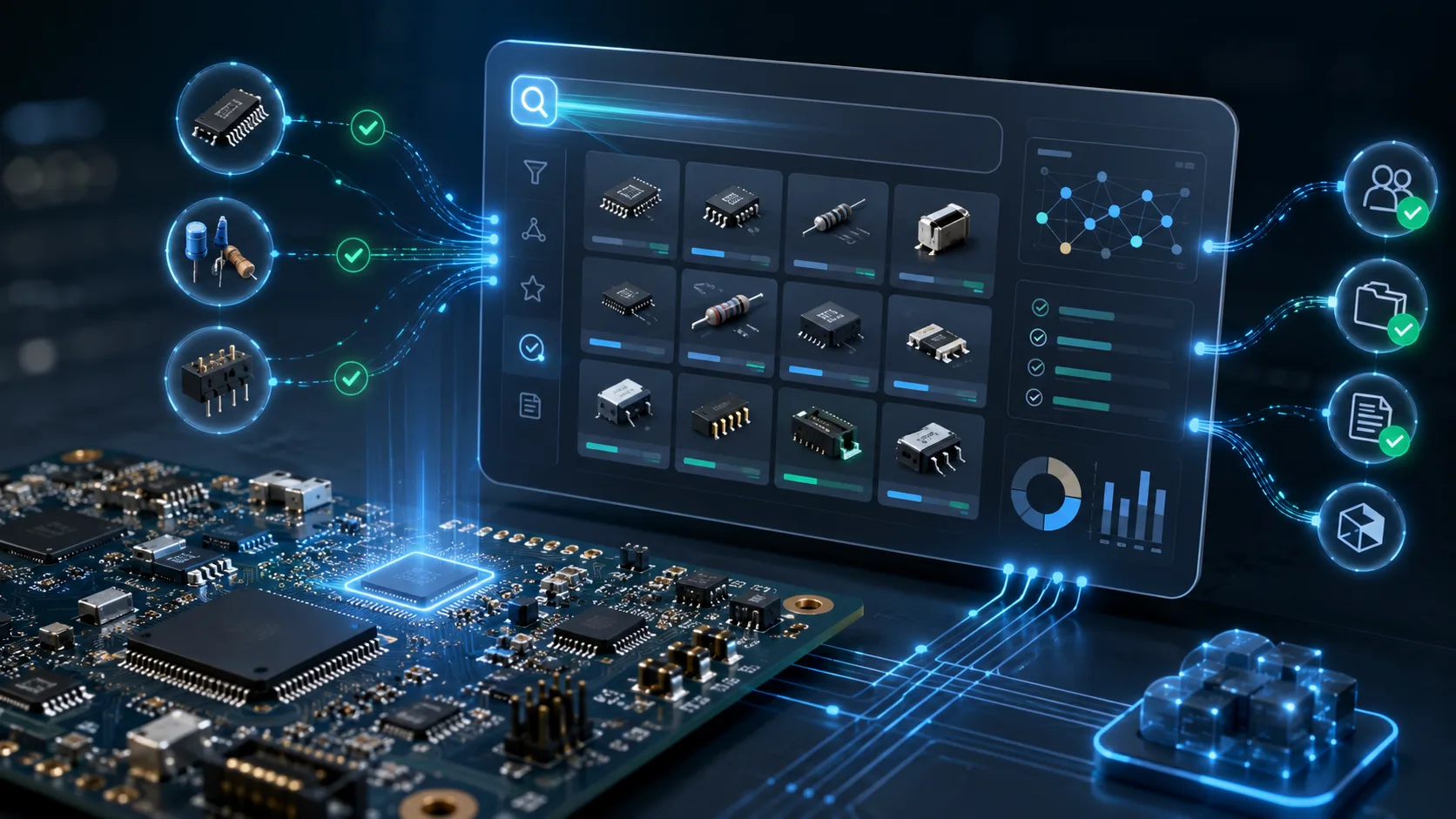
Electronic component data is a crucial foundation for reliable PCB processes. At the same time, finding suitable components, verifying data, and adding missing or correcting inaccurate information can take a considerable amount of time in day-to-day work.
The Electronic Parts Library, or EPL, addresses exactly these challenges. With nearly 2.6 million components, advanced search capabilities, and features for company-wide collaboration, it provides a central platform for searching, managing, and integrating electronic component data.
Nearly 2.6 Million Components in One Central Library
The EPL provides physical models and technical information for nearly 2.6 million electronic components. This data can be used across various stages of PCB development, manufacturing, testing, and assembly.
In combination with PCB-Investigator and related DFM checks, reliable component models help identify potential issues at an early stage. Errors can therefore be corrected before they cause delays or costly rework during production.
Match Components Faster with PartMatcher
The PartMatcher enables users to quickly assign existing components to suitable entries in the EPL.
Instead of searching large datasets manually, companies can efficiently compare their components with the available library data. This reduces the effort required for data preparation while improving the quality and consistency of the component information used throughout the organization.
Find Alternative Components with Free-Text Search
In addition to conventional search methods, the EPL offers semantic free-text search. Users do not necessarily need to know the exact manufacturer name or part number.
Instead, they can describe the required component based on its properties or intended use. The search understands the meaning of the query and can suggest suitable components as well as possible alternatives.
This is particularly useful when:
- a specific component is unavailable,
- an alternative from another manufacturer is required,
- only certain technical requirements are known,
- or possible replacement components need to be compared.
This makes component searches more flexible and better aligned with the user’s actual task.
Add Components to the EPL More Efficiently
The process of adding missing components is designed to be efficient. Companies can suggest new parts using PartRecommendations.
A recommended component is immediately available within the company that submitted it. Internal processes therefore do not need to wait until the entry has been reviewed and published for all users.
At the same time, the EPL team can review the recommendation internally. Once approved, the component can be made available to all EPL users.
This process combines two important requirements: companies gain quick access to the component data they need, while a controlled approval process helps maintain the quality of the global library.
Improve Inaccurate Component Data Directly
Missing data is not the only issue that can be addressed. Incomplete or inaccurate component information can also be reported and corrected using PartReports.
Companies can improve an existing entry and use the corrected version immediately within their own organization. The change can then be reviewed internally and, after approval, added to the shared EPL data.
This allows companies to benefit from their own corrections right away. At the same time, quality-checked improvements can later be made available to all EPL users.
As a result, the library continues to grow and improve over time.
Manage Company-Specific Components Through the Web Interface
A web interface provides a central environment for searching and managing components. It can be used to work with both global EPL data and company-specific content.
Key functions include:
- searching for components,
- managing company-specific parts,
- creating and editing PartRecommendations,
- reporting and correcting component data using PartReports,
- and tracking the relevant review and approval processes.
This gives companies a central platform where they can manage their own component data while also accessing the extensive EPL database.
Integrate the EPL into Custom Applications with the SDK
The EPL includes its own Software Development Kit, or SDK. This allows companies to integrate the component library into their own applications and processes outside PCB-Investigator.
Possible integrations include:
- internal engineering tools,
- material management and ERP systems,
- company-specific component databases,
- automated review and approval processes,
- procurement applications,
- and custom web or desktop solutions.
A demo project is also available to help users get started. It demonstrates how an application can be connected to the EPL and how its functions can be accessed.
This means companies are not limited to using the EPL through a predefined interface. Instead, they can integrate it flexibly into their existing system landscape.
Component Search Through an MCP Connection
The EPL can also be connected through the Model Context Protocol, or MCP.
This interface allows compatible applications and AI-powered systems to access EPL search and filtering capabilities. Components can, for example, be searched and narrowed down based on technical properties, manufacturer information, or other criteria.
An MCP connection creates the foundation for conversational workflows. Users can search for, compare, or preselect components for specific tasks using naturally phrased requests.
Conclusion
The Electronic Parts Library makes working with electronic component data faster, more flexible, and better aligned with the requirements of individual companies.
Users can access nearly 2.6 million components while also actively expanding and improving the library. New or corrected components are immediately available within the company, while an additional review process helps maintain the quality of the global EPL data.
With its dedicated SDK, available demo project, and optional MCP connection, the EPL can also be used far beyond PCB-Investigator. This turns it from a component library into a central data and integration platform for modern electronics processes.