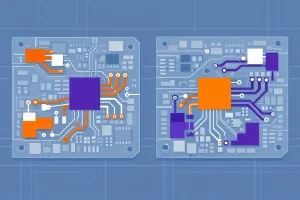

Why open data formats matter in electronics manufacturing
In electronics manufacturing, project success is determined not only by the design itself, but also by the quality of the manufacturing data that is handed over. If CAD, CAM and production do not communicate cleanly, misunderstandings, clarification loops and avoidable errors are the result. This is exactly where open data formats create real value.
Formats such as ODB++, IPC-2581 and Gerber/X2 enable genuine interoperability between design and manufacturing. They help ensure that information is transferred consistently, without losing critical content during export or import steps. This becomes especially important for complex layouts, HDI designs and dense assemblies.
Avoiding common sources of error
One of the biggest advantages of open formats is their ability to carry critical manufacturing data with precision. This is especially important for the following information:
- Layer mapping
- Drill and plated information
- Material stackups
- Component orientations and polarity
When this data is clearly defined and machine-readable, the risk of misinterpretation drops significantly. Instead of manual correction or repeated clarification, manufacturing and inspection teams can work from a reliable data foundation.
Less room for interpretation means more process stability and better manufacturing quality.
Benefits for EMS, engineering and automation
Open standards reduce the number of back-and-forth questions between EMS and engineering. That shortens job turnaround time and helps projects move into production with less friction. At the same time, companies become less dependent on a specific CAD system, which is a major advantage in heterogeneous supply chains.
Another key point is longevity: open formats are maintained over time and evolve alongside industry needs. This creates planning security and also supports modern manufacturing and test processes such as AOI, SPI and Flying Probe, all of which benefit from structured data.
- Less manual interpretation
- Fewer clarification loops
- Greater transparency across the workflow
- More stable quality for complex designs
- A stronger foundation for automation
Conclusion
Open data formats are not a side topic—they are a key enabler of reliable, scalable and modern electronics manufacturing. Clean data exchange reduces risk and creates the foundation for stable processes from engineering through inspection.
If you want to make your manufacturing data handover more robust, it is worth taking a closer look at the formats you use and their impact on the full workflow.