
Why ODB++ matters in modern PCB workflows
When PCB data moves between different CAM systems, the biggest risk is often not the design itself, but the way the data is interpreted. Formats with multiple dialects, such as RS274X, can produce different results depending on the system that reads them. In fabrication and development, that kind of ambiguity can quickly turn into delays, rework, or costly mistakes.
ODB++ solves this by defining PCB manufacturing data in a clear, structured way. Instead of leaving room for multiple interpretations, it consolidates the relevant information into one well-defined dataset.
Less ambiguity, more confidence
With the ODB++ plugin in PCB-Investigator, you can easily import and export ODB++ data. Once a dataset is imported, you can continue using the full range of PCB-Investigator features to inspect, analyze, and validate the design.
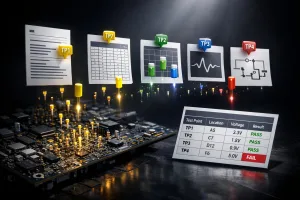
This is especially valuable because all critical information stays connected in a single structure: graphical data, materials, components, netlists, drilling depths, layer definitions, and any additional attributes that may be required. Nothing gets lost in translation, and nothing has to be guessed.
Key advantages for engineering teams
- Unambiguous data exchange with fewer interpretation errors
- Import and export support for ODB++ inside PCB-Investigator
- Complete layer definition including name, type, polarity, and order
- Netlists, drilling depths, and attributes available in one dataset
- Reduced risk of costly issues in CAM and fabrication
A well-defined exchange format is one of the simplest ways to improve process reliability.
If your current workflow still leaves room for data interpretation, it may be time to evaluate ODB++. Explore how PCB-Investigator can help you make PCB data exchange more robust and predictable.