Why creepage matters in high-voltage PCB design
Once a design exceeds 30 V, safety requirements become much stricter. Standards such as DIN EN 60664 / VDE 0110, IPC-2221A, and UL60950-1 define minimum distances that must be met to avoid leakage currents and potential breakdowns.
In real projects, that is not always easy to verify manually. Pollution degree, material group, condensation, and geometric edge cases such as drill holes, board cutouts, and outer contours all influence creepage performance. The result is a task that is time-consuming and prone to interpretation errors.
Automate the shortest-path calculation
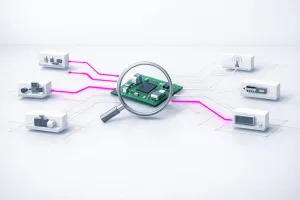
The Creepage Analysis in PCB-Investigator calculates the shortest distance between conductive elements and to the board outline. It also takes uncoated drill holes, mounting holes, and indentations into account, which are often difficult to assess consistently by hand.
One of the biggest advantages is geometric accuracy. Instead of simplifying the path to a right-angle estimate, the software evaluates diagonal routes along edges and holes as they occur in the actual layout. That makes a real difference, especially in thicker stack-ups and safety-critical designs.
The analysis does more than flag a problem: it shows how much of the required minimum distance has already been achieved, in percent.
Support for net, net group, and outline checks
PCB-Investigator supports several analysis modes, including net-to-net, net-group-to-net-group, and checks against the board outline. That gives engineers the flexibility to validate exactly the scenario that matters for a given design.
- automatic shortest-distance creepage calculation
- board outline, routings, and drill holes included
- clear 3D visualization of results
- percentage-based evaluation against the required minimum distance
If a route falls below 100% of the required value, the software highlights the potentially critical path directly in the result view. That helps reduce manual mistakes and speeds up design review.
Better validation earlier in the workflow
For engineers working on functional safety or high-voltage layouts, creepage should be checked early and often. Automated analysis helps turn a complex, manual task into a repeatable design step.
Explore the creepage analysis workflow in PCB-Investigator and test it on your own designs. It is a practical way to improve confidence before release.