
Creepage Analysis: prevent safety issues before they reach production
Once a PCB design moves above 30 V, creepage is no longer a theoretical compliance item. It becomes a practical safety requirement that can decide whether a design passes validation, meets standards, or gets sent back for rework.
In reality, the check is more complicated than measuring a distance between two nets. Pollution degree, material group, moisture, uncoated drill holes, cutouts, indentations, and the board outline all affect the shortest permissible path. A manual review can handle simple cases, but it quickly becomes inefficient in complex high-voltage layouts.
Automatic shortest-path calculation for real PCB geometry
PCB-Investigator’s Creepage Analysis calculates the shortest distance between conductive components and to the board edge. It also includes details such as mount holes and indentations, which are often too time-consuming to evaluate manually.
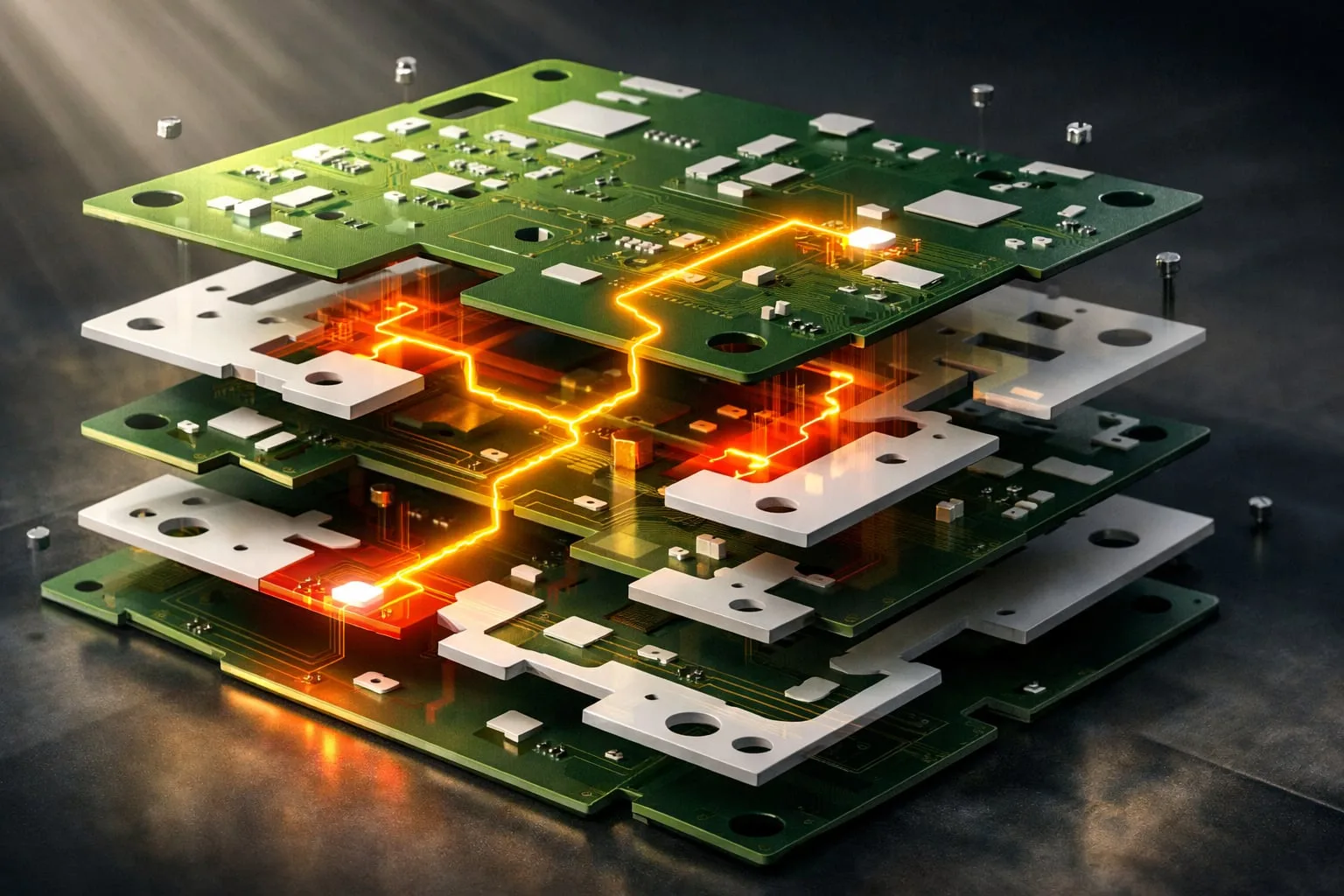
The analysis is displayed in 3D, making the result much easier to interpret in context. Instead of simplifying the path with right-angle assumptions, the software evaluates the actual geometry, including diagonal paths along edges and holes where this matters most.
The result is not just a number. It is a clear view of how much of the required minimum distance is actually achieved.
That percentage-based evaluation makes it easier to identify critical sections immediately. If a path falls below 100%, the risky area is highlighted directly in the analysis result, which speeds up reviews and reduces the chance of overlooking a margin violation.
Why engineers use it
- Net to Net checks for individual signal or power paths
- Net Group to Net Group checks for broader design reviews
- Net to Outline checks for PCB edge clearance
This makes the feature useful both during early design iterations and in final safety validation. For high-voltage applications in drive electronics, industrial systems, or power conversion, it helps reduce manual effort while improving confidence in the result.
If creepage is part of your design constraints, take a look at PCB-Investigator’s Creepage Analysis here: https://www.pcb-investigator.com/en/features/developer-tools/creepage-analysis/ and explore the manual here: https://manual.pcb-investigator.com/pages/creepage_analysis